
Essex County · MA
Roofing Contractors in Ipswich, MA
Fifty-nine houses in this town contain First Period framing, and a mile down Argilla Road the salt spray eats fasteners. Ipswich asks a roofer two different hard questions.
- ZIP codes served
- 01938
- Neighborhoods
- Downtown / Ipswich Village · South Green · Town Hill · East End · Linebrook
- Response
- Same-day emergency tarping
Ipswich has 59 houses identified as containing First Period elements - pre-1725, medieval English timber framing. That is more surviving First Period houses than any other town in the country, and roughly three dozen of them date to the 1600s. The Whipple House went up in 1677. The Choate Bridge has been carrying traffic since 1764.
None of that stock behaves like a modern roof. Hand-hewn rafters sit at spacings nobody standardized. The sheathing is wide board with gaps between the courses, so a nailing pattern that works on plywood puts half your fasteners into air. Pitches run steep, rear slopes drop into saltbox geometry, and a central chimney the size of a small room comes up through the middle of everything.
Then you drive out toward Great Neck, Little Neck or Argilla Road and the problem changes completely. Those houses sit in open Atlantic exposure. The shingles are usually fine; the fasteners underneath are what fail.
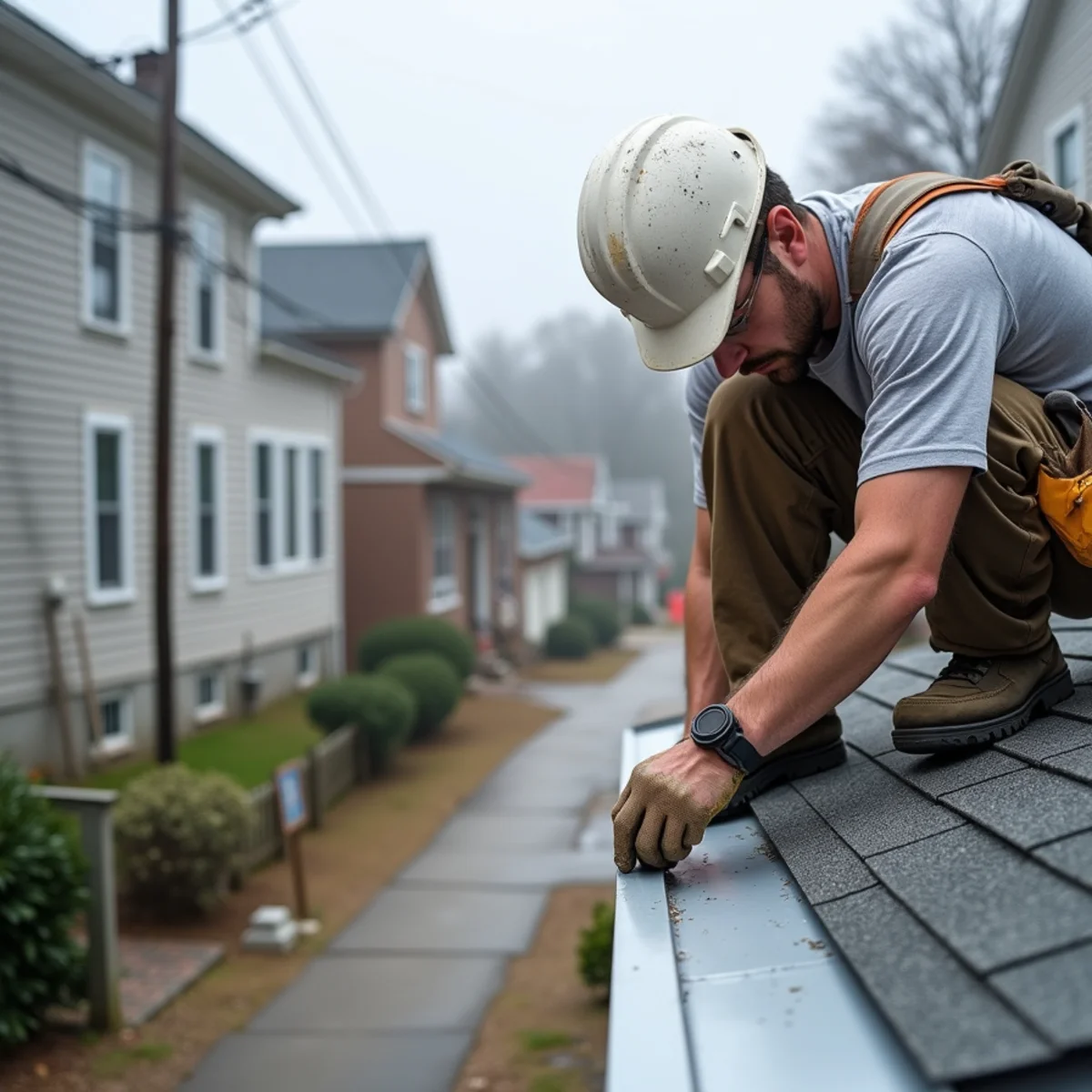
We are fifteen minutes down Route 1A in Danvers. Paulo walks the roof himself before anything goes on paper, because on a house this old the estimate depends entirely on what the deck turns out to be.
Working around Ipswich
Castle Hill and the Crane Estate · Crane Beach · Appleton Farms · Whipple House (1677) · Choate Bridge (1764) · Ipswich Riverwalk
Free Roof Estimate in Ipswich
Ipswich carries a 50 psf snow load, not Boston's 40
Massachusetts assigns design ground snow load municipality by municipality, and Ipswich sits in the 50 psf tier along with Danvers, Gloucester and Topsfield. Boston, Salem, Peabody and Beverly are at 40. That is a quarter more design weight on the same rafters, and on 300-year-old hand-hewn framing it is not an abstraction.
It changes what we will sign our name to. A second layer of asphalt over an existing roof adds dead load to a structure that was never engineered with a number in mind. On antique framing we tear off. Massachusetts requires it anyway where the existing covering is slate or wood shake - those materials can never be overlaid - and on this housing stock that covers most of what we find.
Working on First Period and Georgian framing
The core problem with the oldest houses is that there is no ventilation path and never was. No soffit intake, no ridge exhaust, a chimney mass in the middle, and finished space pushed up under the roof deck over the centuries. That geometry melts snow mid-slope and refreezes it at the cold overhang, which is the textbook recipe for ice dams.
You cannot solve it by cutting a ridge vent into an antique roof and calling it done. Sometimes the answer is air sealing from below and improved insulation. Sometimes it is accepting the geometry and running self-adhering membrane well past what code asks for. We look at the attic, not just the shingles - that is the whole point of the free roof inspection.
State code sets the floor: an ice barrier from the lowest roof edge to at least 24 inches inside the exterior wall line, and at least 36 inches measured along the slope on pitches of 8:12 or steeper. Ipswich antiques are frequently steeper than 8:12. On this stock the code minimum is a starting point, not a target.
Slate, wood shingle and the tear-off rule
A lot of Ipswich roofs are slate or cedar, and the reroofing provisions are clear that slate, clay tile, cement tile, wood shake and asbestos-cement tile always come off rather than getting covered. That makes slate roof repair and restoration piecemeal, careful work - slate hooks and copper nails, matching quarry colour and thickness, not shingle technique applied to a different material.
Great Neck, Little Neck and Argilla Road: the salt problem
The coastal sections of Ipswich sit in full salt-spray exposure, and the outer points fall under the state's windborne-debris provisions. FEMA coastal guidance recommends 300-series stainless fasteners and connectors within roughly 3,000 feet of a saltwater shoreline - exposed and concealed both.
- Standard electro-galvanized nails corrode and bleed rust through the face of the shingle within a few seasons out here. Hot-dipped galvanized is the practical minimum.
- Copper nails are standard for cedar and slate, and stainless for everything else in the spray zone.
- Never mix copper flashing with galvanized fasteners. Galvanic corrosion will destroy the joint, and it usually shows up somewhere you cannot see it until the ceiling stains.
- Edge metal takes the beating. Wind uplift starts at the perimeter, so heavy-gauge drip edge and properly fastened starter courses matter more here than in the middle of the field.
Cottage colonies on the Necks add their own wrinkle: tight lots, seasonal occupancy, and roofs that go unwatched for months. A small flashing or chimney failure that would be caught in a week on an occupied house runs all winter here.
Permits and historic review in Ipswich
Roof permits go through the Ipswich Building Department, not through Boston Inspectional Services. The Ipswich Historical Commission is the body that cares about visible exterior work on the town's historic stock, and getting that conversation started early is much cheaper than getting it started after materials are on site. We pull the permit and close it out, and you keep the paperwork - you will want it when the house sells.
Massachusetts registration matters more than usual on a house like this. The Home Improvement Contractor registration covers the consumer-protection side, and the Construction Supervisor License is the license of record on the permit itself - there is even a Specialty CSL for roof covering, whose scope includes replacing up to 25 percent of sheathing and sistering rafters. On Ipswich antiques that scope limit comes up for real. Verify any contractor free through the state HIC lookup, and read our Massachusetts roofing licence guide before you sign. We work the same routes for roofing in Gloucester and roofing in Beverly.
Ipswich Specifics
What makes roofs in Ipswich different
Every town in this market has its own failure modes. These are the ones we see here.
Gapped board sheathing
Wide-board decking with spaces between the courses will not hold a production nailing pattern. Fasteners have to find wood, which means slowing down and sometimes re-sheathing. It is the single biggest reason an Ipswich antique costs more than a comparable Linebrook colonial.
No ventilation path at all
First Period and Georgian roofs have no soffit intake and no ridge route. Cutting one in is not always possible or appropriate, so the fix is usually air sealing, insulation, and membrane coverage well past code minimum rather than a vent product.
Salt spray on the Necks
Great Neck, Little Neck and Argilla Road sit in the spray zone. Fasteners fail before shingles do. Stainless and copper are standard here, and mixing metals is the mistake that quietly ruins a good roof.
50 psf design snow load
Ipswich carries a quarter more design ground snow load than Boston. On antique framing that argues hard against overlays and in favour of looking at the structure before adding weight to it.
Steep pitches and saltbox rear slopes
Pitches over 8:12 are common, which triggers the 36-inch up-slope ice barrier requirement and makes staging slower and more expensive. Long saltbox rear slopes dump enormous volume onto a short eave.
Most Requested Here
Roofing services we run most in Ipswich
Ordered by what this housing stock actually needs, not by what is easiest to sell.
- 01Slate Roof Repair & Restoration in IpswichSlate, copper and historic roof work. Matched stone, copper hooks and bibs, no tar patches, and historic review handled before the permit is pulled.See details
- 02Roof Replacement in IpswichFull tear-off, deck repair and a code-correct ice barrier. Written scope, permit filed for you, magnet sweep at the end of every day.See details
- 03Ice Dam Removal & Prevention in IpswichSteam ice dam removal, roof snow raking and the attic work that stops the dam from coming back. Photos and dates for your insurance file.See details
- 04Flashing & Chimney Repair in IpswichStep, counter and cricket flashing rebuilt at chimneys, sidewalls and parapets. Crown and mortar repair above the roof line, water tested before we leave.See details
- 05Roof Inspections in IpswichFree, documented roof inspection. We get on the roof, check the attic, and hand you photos, a written report, and an honest verdict.See details
Recent Work
On roofs around Ipswich
Stripped a steep rear saltbox slope on a pre-1750 house near the South Green, re-sheathed about a third of the gapped board decking, then ran full ice-and-water up the whole slope rather than the code strip. Copper at the chimney, stainless everywhere else.
Want addresses in Ipswich you can drive by and look at? Ask when you call. We would rather you saw the work than read about it. Read our customer reviews.
FAQ
Roofing questions from Ipswich homeowners
Yes, and it is a different job from a modern reroof. Hand-hewn rafters, gapped board sheathing, no ventilation route and steep pitches all change the approach. We inspect the deck and the attic first, tell you what we actually found, and price the sheathing work honestly instead of discovering it halfway through.
Massachusetts assigns design ground snow load by municipality. Ipswich is listed at 50 psf while Boston, Salem and Peabody sit at 40 - a quarter more design weight. It is one more reason we tear off rather than overlay on older framing here. Confirm the current value with the town building official before relying on it for design.
Within roughly 3,000 feet of saltwater, FEMA coastal guidance recommends 300-series stainless for fasteners and connectors, exposed and concealed. Hot-dipped galvanized is the practical minimum. Standard electro-galvanized nails will corrode and bleed rust through the shingle face out there.
We do, through the Ipswich Building Department. If the work is visible and the house is historically significant, the Ipswich Historical Commission may want to review it, and we would rather start that conversation before materials arrive than after.
All Pro Phoenix Roofing139 High St, Danvers, MA 01923
Get DirectionsOur shop is at 139 High St, Danvers — a short run to Ipswich on Route 128 and Route 1.
Popular in Ipswich
The three we quote most often at addresses like yours.
- Slate Roof Repair & RestorationSlate, copper and historic roof work. Matched stone, copper hooks and bibs, no tar patches, and historic review handled before the permit is pulled.Learn more
- Roof ReplacementFull tear-off, deck repair and a code-correct ice barrier. Written scope, permit filed for you, magnet sweep at the end of every day.Learn more
- Ice Dam Removal & PreventionSteam ice dam removal, roof snow raking and the attic work that stops the dam from coming back. Photos and dates for your insurance file.Learn more
We also cover these areas near Ipswich
See the full list of 34 Massachusetts communities we serve.
Free On-Site Inspection
Free roof inspection in Ipswich — no obligation
We will climb it, photograph what we find, check the attic where we can get to it, and leave you with a written itemized estimate. If the roof has years left, we will tell you that instead.
- 5.0 from 4 Google reviews
- Licensed & fully insured in Massachusetts
- Written workmanship warranty on every roof