
What to Do After a Nor'easter Damages Your Roof: The First 48 Hours in Massachusetts
Wind gone, water coming in, shingles in the driveway. Here is the exact order to work in during the first two days after a nor'easter, from documenting the damage to standing on the roof with your adjuster.

The wind quit around four in the morning. Now there is a brown stain spreading across the bedroom ceiling and shingles in the driveway. Here is the whole answer up front: stay off the roof, photograph everything before you move any debris, get a real tarp over the opening, call your carrier the same day, and have a licensed Massachusetts roofer on that roof when the adjuster climbs it. In that order.
The order is what people get wrong. Clean the yard before you document it and you lose claim value. Let a stranger with a magnetic truck sign tarp your roof for free and you can lose the claim outright.
This is not a rare event. Massachusetts takes three to five nor'easters in a typical winter, with coastal gusts of 60 to 80 mph. The Blizzard of '78 ran 27.1 inches over 32 hours and 40 minutes, gusted to 111 mph, and flooded Revere. The winter of 2014-15 dropped 110.6 inches at Logan, the snowiest season since records began in 1891.
The First 48 Hours, in Order
- Hour 0 to 1 - make it safe. Kill power to any room where water is running near a light box. If a ceiling is bulging, poke a small hole at the low point so it drains instead of collapsing.
- Hour 1 to 3 - document first. Photos and video, inside and out, before any cleanup.
- Hour 2 to 6 - get it covered. A battened tarp over the ridge, not plastic under cinder blocks. That is what emergency roof repair in Boston is for.
- Same day - open the claim. Get a claim number and write down who you spoke to.
- Day 1 to 2 - book a written [roof inspection in Boston](/services/roof-inspection-boston/). Photo documentation gives the adjuster something real to price.
- Day 2 - meet the adjuster with your roofer present. Two sets of eyes on one roof settle more claims than any phone call.
- Sign nothing until you have a written scope and a number. A tarp is an emergency. A roof is not.
Stay Off the Roof. We Mean It.
Wet asphalt after a nor'easter is a slide. Frozen wet asphalt is worse. Add one more gust and a ladder and the hospital becomes the bigger problem.
Our housing stock makes it harder. A Dorchester or East Boston triple-decker puts you three to four stories up over a rear porch stack that blocks half the ladder points, with board sheathing instead of plywood underneath. Those board gaps are where nails lose their grip. On a story-and-a-half Cape the eave sits low and looks harmless, which is how people get hurt. Use binoculars from the ground.
Document It Before You Clean Up Anything
Adjusters pay for what they can see. Every shingle you sweep into a barrel before the camera comes out was never damaged, as far as the file is concerned.
- Wide shots of every side of the house, plus the debris where it landed.
- Close shots of the damage from a window, a deck, or the neighbor's yard.
- Interior photos of each stain, drip, soaked insulation batt and buckled floorboard.
- Torn gutter hangers and detached downspouts, which belong in the claim alongside any gutter installation in Boston work.
- Your declarations page, so you know your wind deductible before you call.
What a Real Emergency Tarp Looks Like
A tarp is temporary weatherproofing, not decoration. Done right it runs over the ridge and down the far side, wraps around furring strips at both ends, and fastens into solid framing so wind cannot get under it. Done wrong it flaps for two days and lifts the shingles around it.
Ask what happens to the fastener holes afterward. A crew that tarps properly already plans the tear-off around them. We cover roofs during the storm and return for the storm damage roof repair once the scope is settled.
Calling Your Insurance Carrier
Open the claim the same day, even if you doubt the damage clears your deductible. Volume matters. In February 2015 Arbella was tracking toward double its prior-year claim count and a Wellesley Hills agency reported a tenfold jump, nearly all ice-dam driven. The people who called first got adjusters first.
Nobody can pay your deductible
If a contractor offers to cover, waive or rebate your deductible, end the conversation. That is illegal in Massachusetts, and it tells you how the rest of the job would go. Same answer for anyone pushing an assignment of benefits before you have seen a written scope.
Put your roofer on the roof with the adjuster
Adjusters are generalists working a queue. A roofer who can point at a lifted course, a torn step flashing, or a counterflashing pulled out of a chimney reglet gets the scope written correctly the first time. Fixing it by supplement three weeks later is much harder.
What Nor'easter Damage Actually Looks Like Here
Wind-driven rain finds the flashing
Hail is a Midwest problem. Ours is horizontal rain driven under laps at 70 mph for eight straight hours. It surfaces at chimney step flashing, sidewall transitions, skylight curbs and parapet walls. Half our calls the week after a storm are not missing shingles at all. They are roof repair jobs in Boston at a flashing detail that was already marginal.
On the coast it becomes a fastener question
In Revere, Lynn, Marblehead and Quincy, a storm mostly exposes corrosion that started years ago. FEMA coastal guidance calls for 300-series stainless fasteners within roughly 3,000 feet of saltwater, and hot-dipped galvanized is the practical floor. Copper flashing nailed with galvanized fasteners corrodes galvanically. Property within a mile of the mean high-water line also sits in the 780 CMR windborne debris region, which drives heavier edge metal.
Then the snow sits there
Boston averages 49.2 inches of snow a year and is designed for a 40 psf ground snow load; Danvers, Ipswich and Topsfield sit at 50 psf. Those figures come from the 780 CMR table, and your building official can confirm the current value. Freeze-thaw does the slower damage: roughly 92 days a year at or below freezing, but only about 23 that stay below freezing all day. That 69-day gap melts snow into the gutters at noon and refreezes it at the eave by midnight. Reroof after a storm and code requires an ice barrier from the eave to at least 24 inches inside the exterior wall line, and 36 inches up the slope at 8:12 or steeper.
Telling a Real Roofer From a Storm Chaser
Out-of-state crews follow nor'easters up I-95. A few are fine. Many are gone by April with your first insurance check.
- HIC registration. Required under M.G.L. c. 142A on owner-occupied one-to-four unit homes and free to verify on the state licensee list. Hiring unregistered is a c. 93A violation on its face, but Guaranty Fund recovery is capped at $10,000 per project. Verifying beats suing.
- A CSL on the permit. The Specialty CSL for Roof Covering covers up to 25 percent sheathing replacement and sistering rafters, which is exactly what storm damage creates. A real roofer carries both credentials.
- A permit they pull. A Boston reroof with no structural work runs on an ISD short-form permit at $20 plus $10 per $1,000 of work. In Back Bay, Beacon Hill or the South End, Landmarks approval comes first.
- A scope that names materials. Slate, clay tile, cement tile and wood shake can never be overlaid under state reroofing rules.
Handle It Before the Next One Lands
Nor'easters travel in sequence. The storm that opened your roof is often followed by another inside two weeks, and the second one turns a small flashing repair into a gutted ceiling.
Paulo Silva, our owner, walks the roofs and writes the estimates himself. We are licensed and insured in Massachusetts, with HIC and CSL credentials provided with every estimate. Call (209) 758-8550 for same-week storm work, or get a free roof estimate and we will meet you and your adjuster on the roof.
The points above, one at a time
A visual index of what each one actually looks like on a Massachusetts roof.

Killing power to a room where water is running near a light fixture 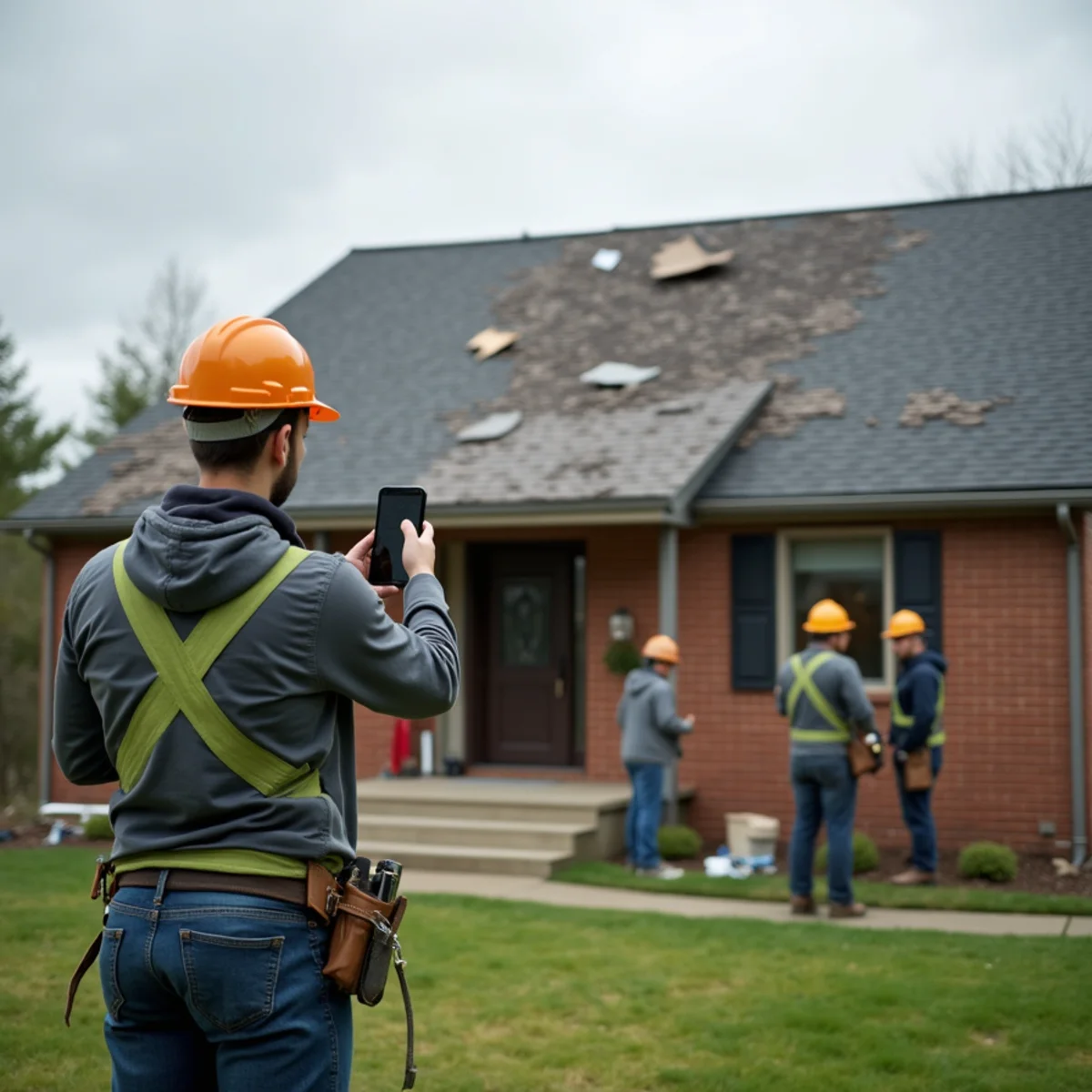
Photographing nor'easter roof damage before anything is moved 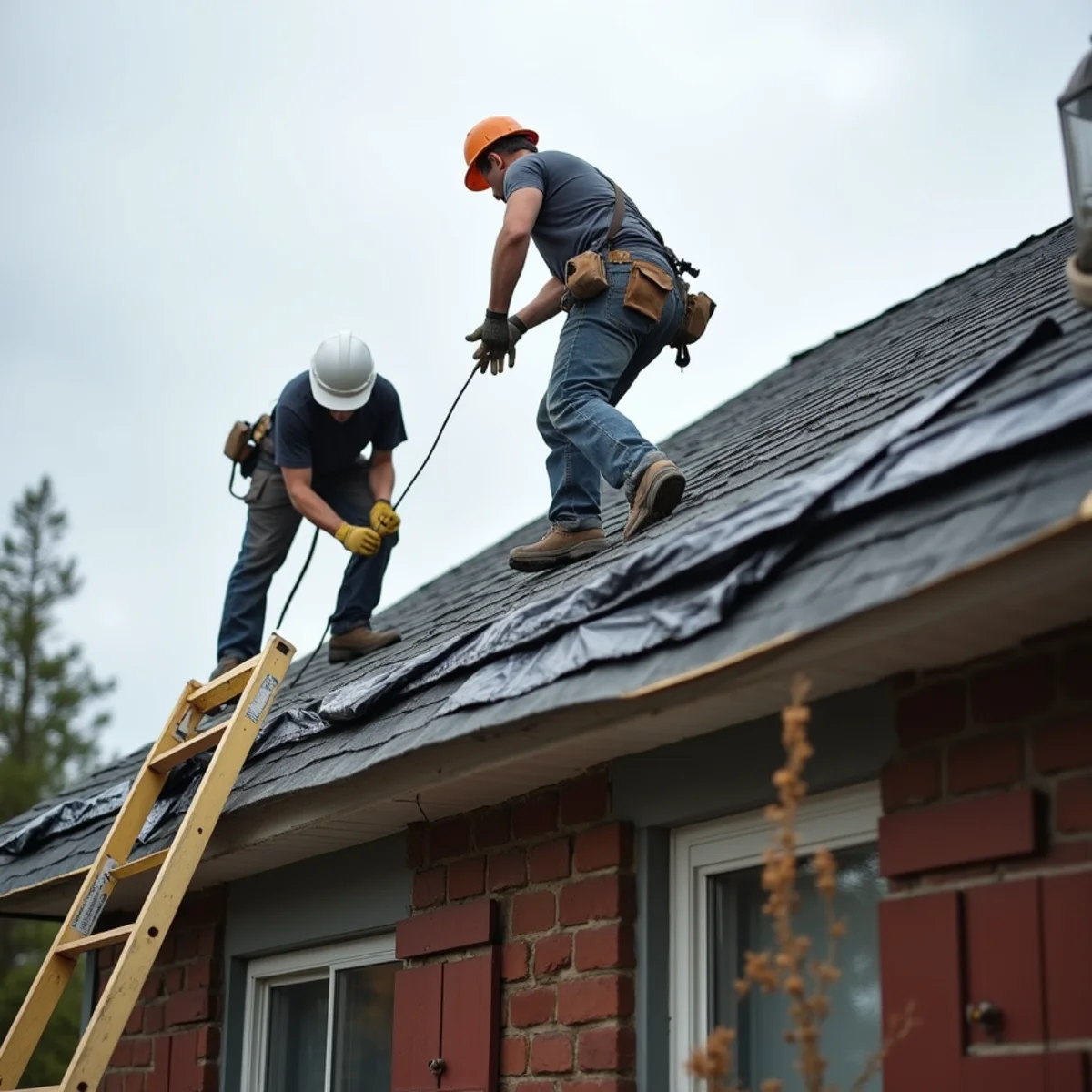
Battened tarp secured over the ridge of a storm-damaged roof 
Opening an insurance claim with damage photos and a written claim number 
Roofer writing a line-item scope during a post-storm roof inspection 
Roofer and insurance adjuster reviewing storm damage together on site 
An unsigned written itemised roofing scope on a kitchen table
Frequently asked questions
Three to five in a typical winter, with coastal gusts commonly in the 60 to 80 mph range. Boston averages 49.2 inches of snow a year across those storms. Outliers happen: the winter of 2014-15 delivered 110.6 inches at Logan, the snowiest season on record since 1891.
Only from the ground, and usually not at all. Wet or frozen shingles are a fall hazard, and a tarp that is not run over the ridge and battened at both ends will lift and pull more shingles with it. Call a roofer for emergency tarping and spend that time photographing the damage instead.
Wind and wind-driven rain damage is generally covered, though many coastal policies carry a separate wind deductible calculated as a percentage of the dwelling value rather than a flat dollar amount. Check your declarations page before you call. Gradual wear, deferred maintenance and pre-existing leaks are typically excluded.
No. Covering, waiving or rebating an insurance deductible is illegal in Massachusetts and is one of the clearest red flags in storm work. A contractor willing to defraud a carrier on your behalf is putting your claim and your name on the line. Walk away and hire someone with verifiable HIC and CSL credentials.
Weeks, not months. A properly installed tarp will hold through a follow-on storm, but sunlight degrades the fabric and every fastener hole is a future leak path. Use the tarp window to complete the adjuster visit and lock in a repair date.