
Replacing a Roof in Beacon Hill, Back Bay or the South End: Landmarks Commission Approval First
Design review is not a formality you handle later — Boston is explicit that Landmarks approval comes before the building permit. Here are the districts, what gets reviewed on a roof, and how to sequence the job.
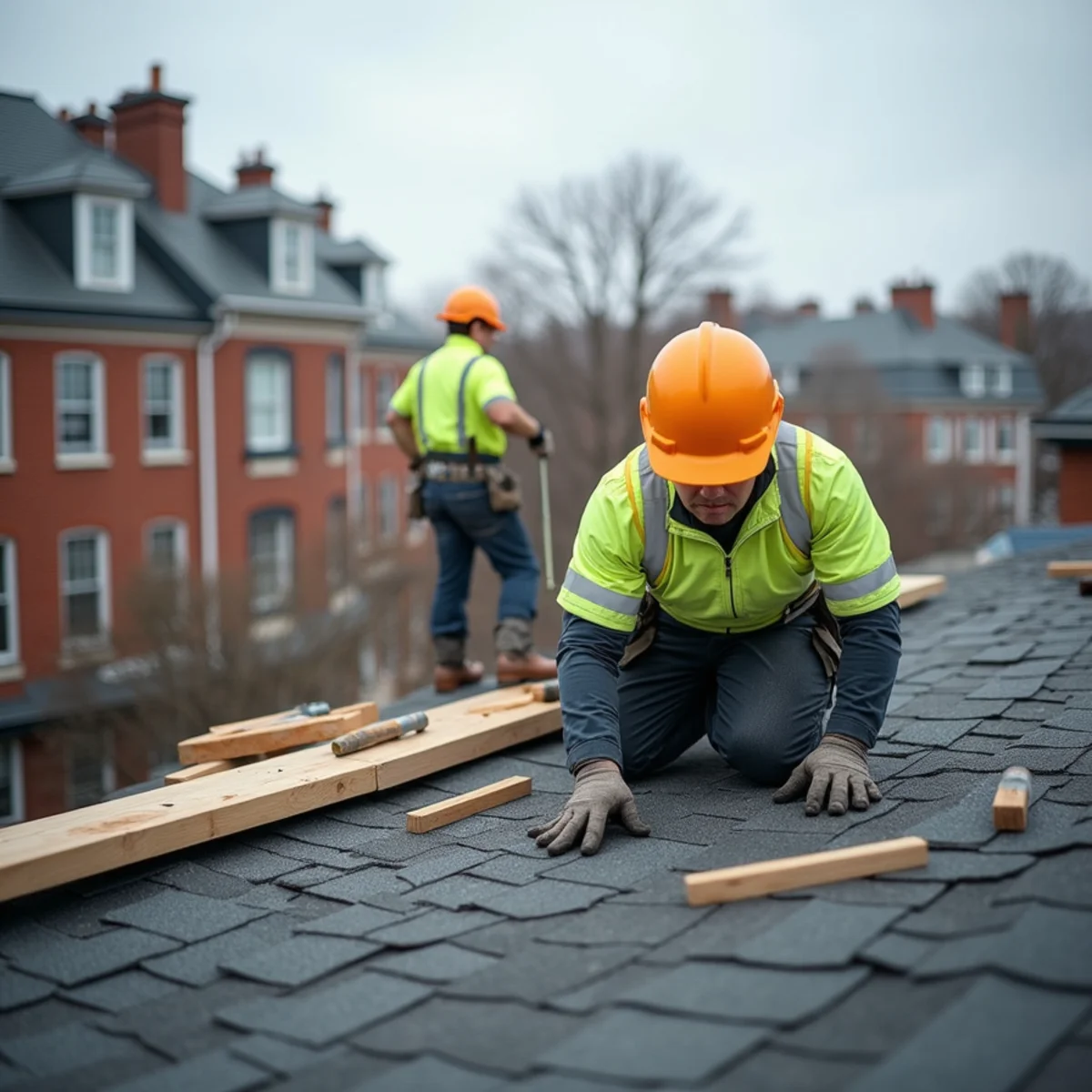
If your property is in one of Boston's local historic districts, the order of operations is not negotiable: Landmarks Commission approval must be obtained before Inspectional Services will issue your building permit. The city says so plainly.
That single sentence changes how you plan the job. You are not scheduling a roof and handling paperwork alongside it. You are scheduling a review, and then a roof.
It also means a contractor who has quoted you a start date without asking which district you are in has not thought about your project properly. Nor easters do not wait for design review, so getting the sequence right in September matters a great deal by February.
Which districts this applies to
Boston Landmarks Commission staff administer design review for the city's local historic district and architectural conservation district commissions. The districts include:
- Historic Beacon Hill District - established 1955, the first local historic district in Massachusetts, and expanded in 1958, 1963, 1975 and 2024.
- Back Bay Architectural District - established 1966, expanded in 1974, 1979 and 1981.
- South End Landmark District
- Bay Village Historic District
- Fort Point Channel Landmark District
- Aberdeen ACD, Bay State Road / Back Bay West ACD, Highland Park ACD, Mission Hill Triangle ACD, and Saint Botolph Area ACD
The commission can be reached at BLC@boston.gov or 617-635-1935. If you are not certain whether your address falls inside a district boundary, that call is worth making before you gather bids rather than after.
What actually gets reviewed on a roof
More than people expect, because in these districts a roof is a visible architectural element rather than a utility.
- Material. Slate versus synthetic, standing seam versus flat-lock, copper versus painted metal.
- Colour and texture. Matching the existing slate colour and thickness, or the patina expectation on new copper.
- Profile and visibility. What can be seen from a public way is what matters most.
- Cornices, dormers and mansard faces. These are the defining features of the district and are treated accordingly.
- Skylights and roof decks. Anything new and visible is a design decision, not a technical one.
Why a Back Bay or South End mansard is two roofs
This is the technical reality behind the design conversation, and it is worth understanding before you read a bid.
The Back Bay was created by filling tidal flats starting in the autumn of 1857 with gravel railed in from Needham. The first houses went up in the early 1860s, filling reached Massachusetts Avenue by 1881, and the western blocks were finished in the early 1880s. Those early townhouses were faced in brownstone with Second Empire trim and a continuous mansard roof running the length of the block.
A mansard is a two-material system. Slate or metal on the near-vertical face, low-slope membrane on the flat top behind it. Those two systems have to meet and stay watertight at a transition that is hard to reach and impossible to see from the street. Most mansard leaks live at exactly that seam, or in a metal-lined box gutter behind the cornice that has no overflow path at all.
The continuous roofline adds a second complication: your work ties into your neighbours' on both sides. You cannot detail your edge in isolation. In the South End, where the mansard became the Boston rowhouse norm around 1860 and bowfront facades create curved cornices and curved mansard faces, that custom slate and metal work is genuinely specialised. It is what our slate roof repair and restoration and standing seam metal work is built around.
Beacon Hill: the staging problem is the project
Beacon Hill is late-18th and early-19th century brick Federal and Greek Revival row houses on narrow, steep, often one-way brick streets. Chestnut, Mount Vernon, Acorn Street, Louisburg Square.
The roofs are shallow-pitch slate, standing seam and flat-lock copper, and low-slope membrane behind parapets, with tightly clustered brick chimneys and copper cricket and counterflashing detail. Genuinely fine work.
The hard part is not the roofing. It is that there is nowhere to stage, nowhere to put a dumpster, and no straightforward ladder set. On a lot of Beacon Hill jobs material comes up and debris comes down by hand. A contractor who has not walked the block before quoting has not priced the job. See our Beacon Hill roofing page for how we approach it.
Sequencing the job so you do not lose a season
- Confirm your district with the Landmarks Commission before you gather bids.
- Get the inspection and a written scope that specifies material, colour, profile and visible detail - that is what review needs.
- Submit for review and understand the hearing calendar. This is calendar time, not work time, and it is the step most people underestimate.
- Then pull the ISD permit. For a non-structural reroof that is a Short-Form Permit at $20 plus $10 per $1,000 of work - see our Boston roof permit guide.
- Then schedule the work, with weather contingency built in.
If you have an active leak in a historic district, that changes things. Emergency stabilisation - tarping, temporary weatherproofing - is about preventing damage rather than altering appearance, and it should not wait on a hearing. Call, do not file a form. Emergency roof repair runs around the clock.
What we will and will not tell you
We do not control commission calendars or outcomes, and any contractor promising you a specific approval or a specific timeline is guessing. What we can do is give you a scope written in the terms review actually cares about, source material that matches what is already on the block, and detail the transitions properly once approval is in hand.
Historic work is slower and it costs more. Anyone quoting a Beacon Hill slate restoration at asphalt-replacement prices has not understood the job. Get a free roof estimate or call (209) 758-8550 and we will walk the roof before anything goes on paper.
Frequently asked questions
If your property is inside the Back Bay Architectural District, yes - and it must come before Inspectional Services will issue the building permit. Material, colour, profile and any visible change are all in scope. Contact the Boston Landmarks Commission at BLC@boston.gov or 617-635-1935 to confirm your address.
It depends on the commission's hearing calendar and on how complete your submission is, so no honest contractor can promise you a date. The practical advice is to start the process well before you want work done, and to submit a scope that specifies material, colour and profile clearly the first time.
Emergency stabilisation to prevent further damage - tarping, temporary weatherproofing - is a different category from an alteration to appearance. Do not let a house take on water while waiting for a hearing. Call us, get it stabilised, and then handle the permanent repair through the proper sequence.
Because it is two roof systems, not one. Slate or metal on the near-vertical face, low-slope membrane on the flat top behind it, and a transition between them that is difficult to reach. Add curved cornices on a South End bowfront, a continuous roofline shared with the neighbours, and a metal-lined box gutter with no overflow path, and it becomes custom metalwork rather than a shingle job.
No. The Boston Landmarks Commission's jurisdiction stops at the city line. Cambridge, Salem, Marblehead, Brookline and Newton each run their own historical commissions with their own procedures. The review-before-permit principle generally holds, but the body and the rules differ.